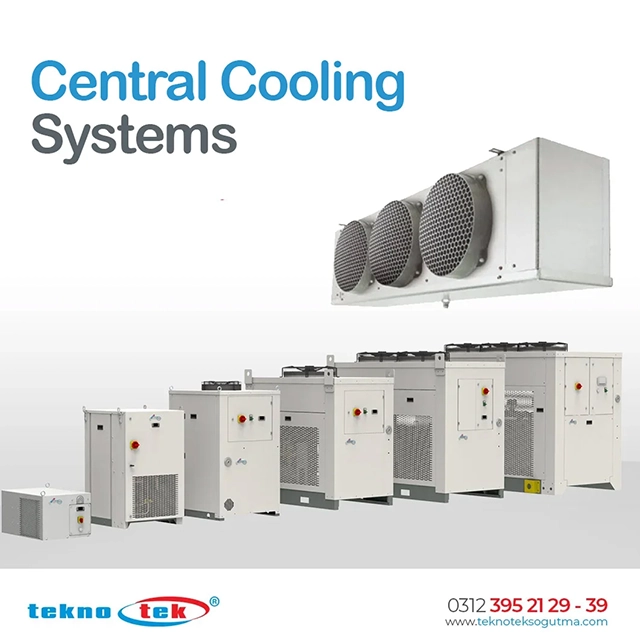
Central Cooling Systems are the cooling machines gathered in a single center. It is the most effective cooling system that provides energy saving and ease of installation. The product is produced as a boutique to produce solutions for special needs.
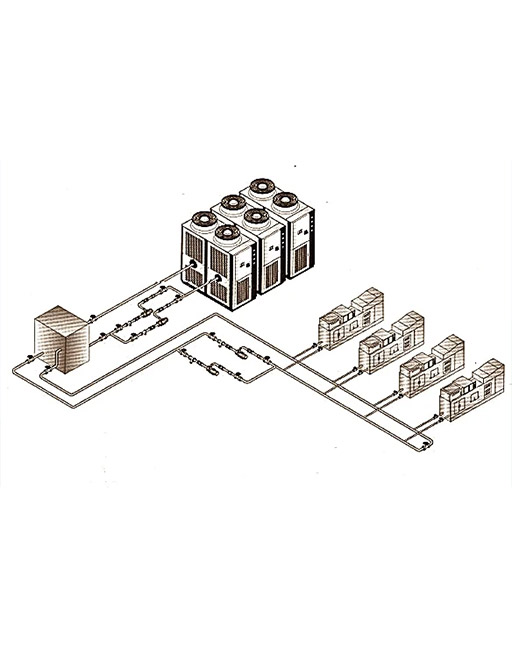
Central Cooling Systems , it is seen that the installation is made simpler with the materials taken from the main line to the coolers. This installation is easier to construct and then maintain for the central system . In individual systems, coolers and each cooling group ( condensing unit ) pipelines form a dense-complex installation.
Central Cooling Systems Technical Specifications
the working principle of central cooling systems ? In these systems, the current capacity of the currently running compressor is used, without a new compressor being constantly activated for the cooling needs signals coming from each cooling point. In this way, it is possible to save electricity between 20% – 30%. In this way, the system pays for itself in 4-5 years.
The units consist of anti-vibration elements and compressors of various sizes connected in parallel on a solid chassis. These compressors can range from 0.5 HP 2-cylinder compressors to 80 HP 8-cylinder compressors, depending on the size of the system. You can examine other features of central type cooling systems from the list below.
- Semi- hermetic , scroll or screw compressor.
- is produced with air or water cooled condenser .
- is shipped ready for installation together with the electrical panel and all automatic control elements .
- Indoor and outdoor units are delivered with nitrogen charge.
- an electrostatic painted steel galvanized chassis.
- There is a compressor system that is activated gradually.
- Large capacity options are available.
- Condenser and evaporator selections are made according to the capacity
Advantages of Central Cooling Systems
- It is produced in accordance with world standards.
- Provides highly efficient cooling.
- It includes quality and reliable equipment.
- It has a design that provides easy installation and assembly.
- It adapts to different mounting styles.
- There is an external cabin unit that provides easy maintenance.
- It is produced in accordance with HACCP standards.
- evaporator design that minimizes moisture loss in the stored product .
- defrost time intervals and reducing the number of defrosts .
- reduces operating costs thanks to its long cooling periods without defrost .
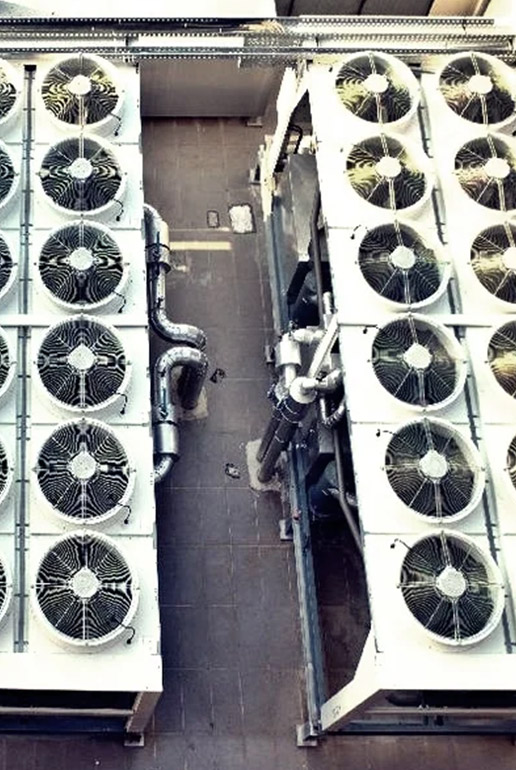
The central cooling system can be used for different purposes such as home or industrial cooling . Teknotek , one of the condenser manufacturers , has solutions such as cold storage .
If you want to benefit from our high standard services at affordable prices, you can contact us via the contact information on our website. Technotek As Cooling Systems , we continue to satisfy our customers and grow with our products.
Central cooling system prices
The prices of central cooling systems vary depending on the capacity of the system to be installed, the size of the area to be cooled, the intended use, and the technical specifications of the equipment chosen for the project. In particular, the daily cooling needs of the business, room or warehouse volumes, ambient temperature, product storage conditions, and operating hours play a significant role in determining the correct system capacity. Therefore, it is not possible to use a central cooling system of the same capacity and cost for every business.
Central cooling systems involve many different components working together, such as compressors, condensers, evaporators, expansion elements, control equipment, and piping. The capacity and technical specifications of the equipment used can directly affect the price of central cooling systems. In addition, installation, electrical connections, automation, insulation, piping, and commissioning are also considered in determining the total project cost. A system designed to meet the needs can prevent unnecessary capacity investment and help keep energy consumption under control in the long term. Therefore, when evaluating prices, not only the initial investment cost but also the system’s efficiency, operating expenses, and lifespan should be considered.
Working principle of central cooling systems
Central cooling systems operate on the principle of circulating refrigerant in a closed circuit and transferring heat from the environment to be cooled to the outside through the system. In central systems, multiple cooling points or sections can benefit from a common cooling infrastructure. Thus, the cooling needs of different areas can be controlled from a single center, and the system’s operating conditions can be managed more efficiently.
The cooling cycle is based on a compressor, condenser, expansion element, and evaporator. The compressor compresses the low-pressure refrigerant to a high-pressure and high-temperature state. The refrigerant then reaches the condenser, where it condenses, releasing its heat to the outside environment. The pressure and temperature of the refrigerant are reduced as it passes through the expansion element. The refrigerant then reaches the evaporator, where it evaporates, absorbing heat from the environment to be cooled. The resulting low-pressure gas is sent back to the compressor, and the cooling cycle continues in the same way.
Thanks to the operating principle of central cooling systems, the needs of cold rooms, warehouses, production areas, and different cooling points in large-scale businesses can be met through a central structure. Accurate system capacity determination, compatible equipment selection, and proper automation control are crucial for maintaining cooling performance and energy efficiency. Therefore, when designing a central cooling system, not only the immediate cooling needs but also the future capacity requirements of the facility should be evaluated.
Frequently Asked Questions
Central cooling systems can be used in cold storage facilities, food processing plants, supermarkets, manufacturing plants, restaurants, hotels, and industrial areas requiring cooling at varying temperatures. In businesses with multiple cooling points, a centralized structure makes it possible to manage all cooling needs through a single system.
In a central cooling system, multiple cooling points utilize compressors and equipment located in a common center, whereas in individual systems, a separate cooling unit can be used for each cooling group. Therefore, in businesses with numerous cooling points, central systems can offer the advantage of a more organized installation and centralized control.
When selecting a central cooling system, factors such as the volume of the areas to be cooled, the target temperature values, product storage conditions, daily usage time, and the total cooling capacity of the facility should be considered. Accurately determining the capacity of equipment such as compressors, condensers, and evaporators is crucial for the efficient and long-lasting operation of the system.
The number and capacity of compressors to be used are determined according to the total cooling needs of the project. Depending on the size of the system, multiple compressors can be used in parallel. The gradual activation of compressors helps the system adjust its capacity more controllably when cooling needs change.